1080×1080 · instagram-square
God's Permission vs. God's Causation
THE PROBLEM OF EVIL · DIVINE PERMISSION VS CAUSATION
Ready-To-Post Teaching
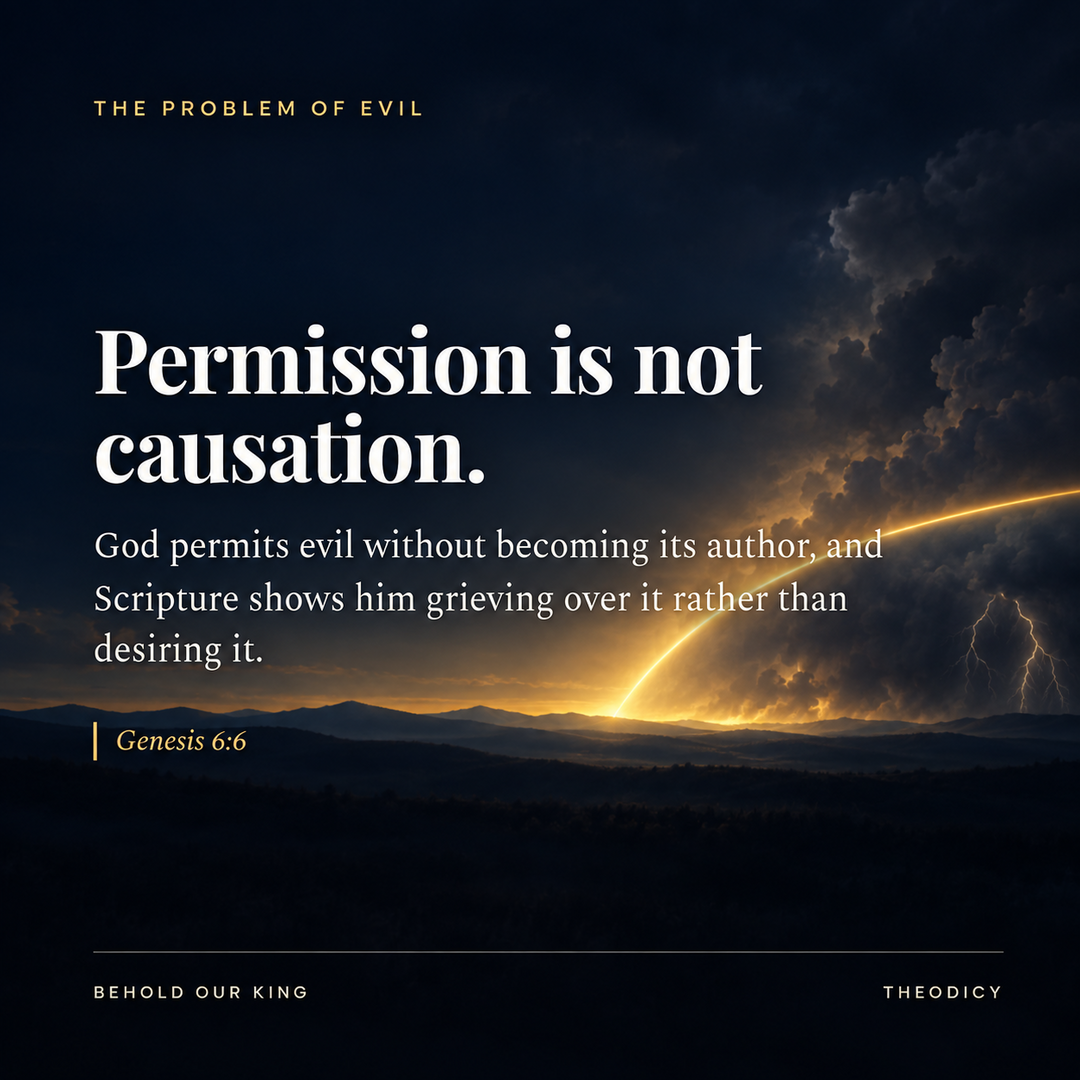
"Yahweh was sorry that he had made man on the earth, and it grieved him in his heart" (Genesis 6:6). This is not the language of a God who causes evil and shrugs; it is the language of a God who grieves over what creatures have made of their freedom. The distinction between what God permits and what God causes is not a semantic trick — it is the hinge on which the whole biblical picture of divine sovereignty turns.
Popular theology often collapses divine sovereignty into exhaustive causation — the idea that God predetermines and directly wills every event, including every sin, so that nothing happens which he did not personally script. Scripture resists this at every turn. The prophet Jeremiah is shown a potter reworking clay at the wheel, and God draws out the lesson himself: "At the instant I speak concerning a nation, and concerning a kingdom, to pluck up and to break down and to destroy it; if that nation, concerning which I have spoken, turns from their evil, I will repent of the evil that I thought to do to them" (Jeremiah 18:7-8). A God who caused every outcome unilaterally would have nothing left to "repent" of — no path remaining open for a nation's own choice to change what happens next. The same responsive structure runs the other way: God can intend to bless, yet withhold that blessing if rebellion follows. Even divine wrath fits this pattern rather than breaking it — anger, in Scripture, is never the source of evil; it is love's own proper, temporary reaction to what already offends it. Permission means God allows a real possibility he does not personally manufacture and takes no delight in — his own grief in Genesis 6 proves the point better than any doctrine could.
This is why the flood narrative can hold together two things that would otherwise contradict each other: a God sovereign enough to judge the whole earth, and a God genuinely grieved by what brought that judgment about. Sovereignty that governs history's outcome is not the same claim as sovereignty that authors every sin within it. "Yahweh was sorry that he had made man on the earth, and it grieved him in his heart" (Genesis 6:6) — a heart that grieves is not a heart that willed the grief into being.
What the Scripture Says
- Genesis 6:5-6WEB
Yahweh saw that the wickedness of man was great in the earth, and that every imagination of the thoughts of man's heart was continually only evil. Yahweh was sorry that he had made man on the earth, and it grieved him in his heart.
- Jeremiah 18:7-8WEB
At the instant I speak concerning a nation, and concerning a kingdom, to pluck up and to break down and to destroy it; if that nation, concerning which I have spoken, turns from their evil, I will repent of the evil that I thought to do to them.
Hashtags
#BeholdOurKing #DivinePermission #Theodicy #Sovereignty #Scripture